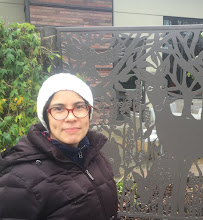
First class I arrived 10 minutes early and took a seat in the front center row. Students began piling in and soon all the seats were taken. I couldn’t see everyone, since they were all behind me, but I did see lots of young faces, some older. The instructor sidled in through the tight desks. An older gentleman, up in his years. I seem to keep finding myself amongst the matures. That suits me just fine. This day he was wearing one of those caps, the sort I could see a writer wearing in a French café.
We began talking about character. He said that, “Most people think they can visualize film, but it does not happen in the obvious description, but in the character—the character’s wants and desires.”
I thought it interesting too that he said most cultures go through the emotions, that is except for the French. They tend to go through the mind. It made me think about the few French movies I have seen. Yes, I can see that—the mind.
A character chooses to go for something or is forced into something—forced into an adventure. We are reminded that, “Characters are not people.”
Another reminder, and something that most storytellers and writers know is, “First thing is to grab an audience and have something that ‘pays off’ in the end.”
Why do we see films? He says that everyone goes to see a film for the emotional experience. Some people like the same experience over and over, while other’s like new experiences.
We talk about the differences between characterization and character. Simply put, characterization is what we can observe in other people. As he says, they are the “External accoutrements of our life.” A character is what a person or a character will do under pressure. We need to put a character under stress to see how they will react.
The book for our class is Robert McKee’s, Story: Substance, Structure, Style, and the Principles of Screenwriting. I’ve had this book on my shelves for about 12 years when a friend mentioned it back then. I only read a few passages here and there and it stayed on the shelves collecting dust. Now, the book reenters my consciousness. Everything is going along fine in reading up to the point of when McKee talks about story, which is early on. I realize I’m in over my head, but hell, I’m here, so I may as well stay and get what I can out of the ride. I’m a reflective writer, a journaler, an observer. Sometimes an essay, a poem, maybe a story. But, I don’t believe I’m a natural storyteller in the sense of creating characters. I observe characters, but I’m afraid to put them through conflict. I’m afraid because I feel out of control with this scriptwriting business, but I feel that I’m right where I’m supposed to be. I can already get glimpses that my prose writing is going to pose conflicts to fit myself into this container that seems so precise, where I need to dig deep into my characters who don’t even exist right now. What I’m finding is I keep coming back to my own experiences and I don’t want to do that. My personal material usually finds its way into my reflective and essay writing. But to bring it to this container feels naked, feels scary. It’s difficult to explain, especially since the class has only begun, but I can feel a resistance within myself. And even McKee cautions against the “personal story.”
I only know how to write truth, with the few exceptions where a tale has come out of me.
Two statements that McKee makes in his book that ring loud in my ears and make me ask myself if I’ve got what it takes are: “A storyteller is a life poet” and “Story talent is primary, literary talent secondary but essential.” I am hopeful that I at least get a glimmer of what it takes.
In the end, will I be able to create a story with characters that are real, multi-dimensional, and make the audience feel? I operate from my emotions, but I don’t know that this will be enough to help me with the story aspect.
Showing posts with label reflections. Show all posts
Showing posts with label reflections. Show all posts
Tuesday, August 24, 2010

Subscribe to:
Posts (Atom)